Neo Earth

Showing posts with label Tuesday's class. Show all posts

Wednesday, June 1, 2011

Tuesday, May 30th's Class


Hello Everyone!!!


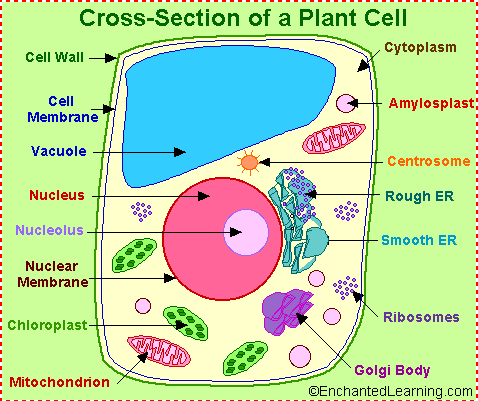
On Tuesday, everything started out with every student saying what was most creative in their Cell Project, and why they used it. These were later handed to Ms.D for grading. Also, there were many things that were due on Tuesday. First, we had to do the last blog comment of the year. Then, there was also a Reflection Post that was due. Here are the directions to the past homework. Later, we discussed the many things that will be happening this week. First, there will be a Cell and Microscope Quiz Friday for all of the seventh graders. Remember, this is the last big grade of the quarter (along with blogging), so study hard!! The picture above shows a plant cell with all its parts, so it might help to study! Here is a fun link that helps you review the different parts of a cell! Basically, what we have to study is the following:


  • The different Organelles of a Plant and Animal cell


  • Microscope Parts- Here are my notes for the Microscope parts:


  • Magnifies small objects so humans can see them better.


  • Types of microscopes- simple, compound, electron and light.


  • Simple- only 1 lens to magnify objects,


  • Compound- 2 or more lenses used to magnify,


  • Light- magnifies as far back as cells! Refracting light.


  • Electron- magnify from electron level, amazing resolution.


  • SER (scanning electron microscope)- outer of organisms,


  • TEM (tunneling electron microscope)- inside of organisms.


This is a picture of an Animal Cell!

Here is a Video that might help you revise for cells!!


We also have to study the organization of everything. Here it is!

Strings(?)- quarks (6)- protons, electrons, and neutrons- atoms- molecules- elements- compunds or mixtures- DNA (Deoxy-Ribonucleic Acid)- cells- tissues- organs- systems- organisms- species- Genus- Family- Order- class- Phyllum- kindoms(6)- Biomes- Planets- galaxies- cluster of galaxies- Universe- ?

Basically, it is how everything in the universe is classified, from smallest to greatest. The question mark on the string is because scientists are not sure if there actually are the strings. Also, the one after the Universe is because no one knows if there is something bigger yet.
Later in the class, we started talking about our Cell Lab. Ms.D gave us the worksheets and we continued started working. The partners were the same we had had for our practice Lab, or numbers 7 on our appointment clock.

Here are some pictures of the people that worked together!


Courtney (and me)!


Tamara and Ghazaleh!


Karin and Maria Chiara!


Eric and Dave!


Valentina and Emilija!


Finally, our homework is to STUDY!!!!!!! Study as hard as you can, because, as I already said, the test will be the last final grade of the quarter!!


Here is a link to Moodle!


I hope you all enjoyed my post!!!


Oh, and I almost forgot.....The next scribe is........amazing, humongous final drum roll of the year..... JAKUB!!!


Wednesday, March 23, 2011

Ben's Scribe Post for Tuesday's Class

Tuesday, March 22, 2011


Hello Grade 7 and 8,


The first thing we did on Tuesday's class was talk about what will happen over the next two weeks. Here is a link to moodle so you can plan ahead. Also, we have a quiz on tuesday (March 29) about work, power, the math for work and power, and all the simple machines. After that, we began the remaining presentations on simple machines.


First up was Nathan and Jakub. Their powerpoint was about the Wheel 
and Axle. I took some notes about the presentation so you can use this post 
as a study guide. Here they are:
  • The wheel and axle is a simple machine made of a large wheel secured to a smaller wheel which is called an axle
  • It is a rod attached to a wheel and their movements are the same when one of the parts is turned
  • Some examples are: a doorknob, a steering wheel, fan, and a windmill
  • It decreases distance and increases output force
  • Mechanical Advantage= radius of wheel ÷ radius of axle


The next presentation was the pulley by Valentina and I. Here is some 
information about pulleys:


  • There are three types of pulleys, Fixed, Movable, and Block and Tackle
  • Mechanical advantage= length of input force/ length of output force
  • Fixed pulley changes the direction of force
  • Mechanical advantage=1
  • Examples are fitness machines, flagpoles, and blinds
  • Movable pulley decreases the amount of input force required
  • Mechanical Advantage=2
  • Common uses are in cranes or tow trucks
  • Block and Tackle pulley is a combination of fixed and movable
  • Its mechanical advantage=3
  • Mechanical Advantage for this pulley relies on how many sections of rope there are
  • Used to lift loads, fitness machines, and cable cars (gondolas)

The final presentation for Tuesday's class was the screw by Courtney 
and Tamara. They had a powerpoint as well. Here are my notes from the 
presentation:
  • A screw is an inclined plane wrapped around a cylinder
  • Inclined plane forms the threads on a screw
  • Types are countersunk, round head, raised head, coach screw & twinfast
  • Names of screw heads are slotted, philips, and crossed slot
  • Shank is the space between the head and the threads of the screw
  • Core is the rod inside of the screw
  • Mechanical advantage= length around threads ÷ length of screw
  • Examples - jar, faucet, swirly slide, drill bit, screwdriver, boat propeller
  • Increases distance of output force


That's it Tuesday's class. Emilija & Maria Chiara started their presentation, but
we ran out of time shortly after they started. On Thursday they will present, 
along with David and Davide who haven't done their presentation yet. For 
those who are presenting, remember to practice beforehand, know your 
information, and be able to define it. I hope you enjoy reading my post.

Here is a link to a website on simple machines, it has a small quiz on it, so 

you can prepare for next Tuesday's quiz, click here.


THE SECOND TO LAST SCRIBE OF THE QUARTER IS......... DAVID!

Wednesday, December 8, 2010

Ping Pong, Tennis, and Soccer ball Lab

Tuesday, December 7th's Class

Hey everyone! In class on Tuesday, we started out by checking our previous homework, which was to graph the data for the Ping Pong, Tennis, and Soccer ball Lab! This consisted in drawing either one or three graphs with the data of the lab. After having Ms.D check our homework, we discussed on how to draw a curve line on our graph. These lines helped us to find out the outliers (outliers: points on a graph that have nothing to do with the other ones, and are proved wrong) . Here is a possible example of an outlier:

This graph is showing how fast some boys were running for 3200 meters. As you can see, there is a red line in the middle, which shows the average speed and the average time. All of the dots that are far from the line, are examples of outliers! Notice that some are on top of the line and some are under, showing how some boys took more time to travel the distance than others.

This is a picture of a dotted graph which is similar to the ones that we were working on in class. Even though this graph has the dots connected, we haven't connected them yet.


During the continuation of the class, Ms.D gave us our quizzes back, which we saw, but couldn't keep, since Tamara, Vale and Chiara haven't done them yet. Once we saw our grade, Ms.D gave us the rest of the class to finish the lab.

Here are the questions we worked on:

1) What was your speed for the ping pong ball? tennis ball? soccer ball?
2) What was the speed of the person behind you (down the hill) for the ping pong ball? tennis ball? soccer ball?
3) What was the speed of the person in front of you (up the hill) for the ping pong ball? tennis ball? soccer ball?
4) What is happening on your graph? Please use scientific vocabulary to explain this in a paragraph (5 sentences min)
5) If the hill went down and then back up and we rolled a soccer ball along the entire thing, what you expect the graph to look like and why?
6) What are some of the possible errors in this lab? (4 minimum)
6) In one sentence, explain the main concept of acceleration.
7) In one sentence, explain the difference between acceleration and deceleration.

Here is the link to moodle if you want to print the sheet out:http://zagreb.ceesa.net/course/view.php?id=188

Here is an interesting website that explains what time is: http://www.historyforkids.org/scienceforkids/physics/time/

Here is a video talking about best fit lines and scatter plots...can you identify some outliers in the graphs this man is drawing?? http://www.youtube.com/watch?v=i1uKiZpkl9A&feature=related


Homework:
Our only homework for Thursday is to finish the lab. REMEMBER to do your fourth blog comment for Friday, and 7th graders,keep in mind that by the end of the quarter, you will need to have made four comments to our class, and three comments to the 8th grade blog!!

The next Scribe is......drum roll......Tamara!!!!