Neo Earth

Showing posts with label Scribe Post. Show all posts

Monday, June 6, 2011


THURSDAY'S CLASS


Hello everyone! Thursday's class was simple! We did a cell lab which was really really fun because we saw the different types of cells, not just that but we also learned how cells work and the different types of cells!


Now let's take a look on the actual microscope that we were using in class!

As you can see, there are many parts on the microscope, but they forgot to label the switch whitch is down at the bottom kind of below the light source!


Now let's talk about the cells!


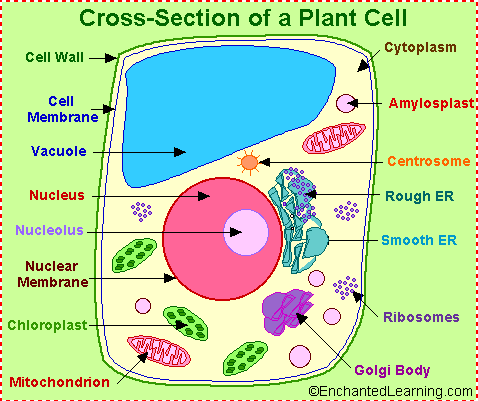
There are many different types of cells that we were exploring in class! There are plant cells, animal cells and many more! The ones that we were exploring in class were these two, but it was still fun to learn about them! Here is a picture of a plant cell and animal cell that might help you! It's also labeled!


Links:


Wednesday, June 1, 2011

Tuesday, May 30th's Class


Hello Everyone!!!


On Tuesday, everything started out with every student saying what was most creative in their Cell Project, and why they used it. These were later handed to Ms.D for grading. Also, there were many things that were due on Tuesday. First, we had to do the last blog comment of the year. Then, there was also a Reflection Post that was due. Here are the directions to the past homework. Later, we discussed the many things that will be happening this week. First, there will be a Cell and Microscope Quiz Friday for all of the seventh graders. Remember, this is the last big grade of the quarter (along with blogging), so study hard!! The picture above shows a plant cell with all its parts, so it might help to study! Here is a fun link that helps you review the different parts of a cell! Basically, what we have to study is the following:


  • The different Organelles of a Plant and Animal cell


  • Microscope Parts- Here are my notes for the Microscope parts:


  • Magnifies small objects so humans can see them better.


  • Types of microscopes- simple, compound, electron and light.


  • Simple- only 1 lens to magnify objects,


  • Compound- 2 or more lenses used to magnify,


  • Light- magnifies as far back as cells! Refracting light.


  • Electron- magnify from electron level, amazing resolution.


  • SER (scanning electron microscope)- outer of organisms,


  • TEM (tunneling electron microscope)- inside of organisms.


This is a picture of an Animal Cell!

Here is a Video that might help you revise for cells!!


We also have to study the organization of everything. Here it is!

Strings(?)- quarks (6)- protons, electrons, and neutrons- atoms- molecules- elements- compunds or mixtures- DNA (Deoxy-Ribonucleic Acid)- cells- tissues- organs- systems- organisms- species- Genus- Family- Order- class- Phyllum- kindoms(6)- Biomes- Planets- galaxies- cluster of galaxies- Universe- ?

Basically, it is how everything in the universe is classified, from smallest to greatest. The question mark on the string is because scientists are not sure if there actually are the strings. Also, the one after the Universe is because no one knows if there is something bigger yet.
Later in the class, we started talking about our Cell Lab. Ms.D gave us the worksheets and we continued started working. The partners were the same we had had for our practice Lab, or numbers 7 on our appointment clock.

Here are some pictures of the people that worked together!


Courtney (and me)!


Tamara and Ghazaleh!


Karin and Maria Chiara!


Eric and Dave!


Valentina and Emilija!


Finally, our homework is to STUDY!!!!!!! Study as hard as you can, because, as I already said, the test will be the last final grade of the quarter!!


Here is a link to Moodle!


I hope you all enjoyed my post!!!


Oh, and I almost forgot.....The next scribe is........amazing, humongous final drum roll of the year..... JAKUB!!!


Wednesday, May 25, 2011

Homework and Cells

Nathan's Scribe Post for Tuesday, May 24

The first thing we did today was discuss the homework assignments we had and when they were due. Our homework is to:
  • Do a reflection post after posting your scribe post (Due May 31st)
  • Our last blog comment (Due May 31st)
  • Cell Project(Due May 31st)
We also have a cell quiz coming up next week, and the rat dissection is taking place on June 7th.

For the Cell Project, what we have to do is use everyday objects to create a representative model of an animal cell or a plant cell. For each organelle, we need to choose an object that symbolizes or represents the organelle’s function. Next, we create a table which lists each organelle you have represented in your model. For each organelle, state its main function. For more information about the project or the rubric, it's in grade 7 science, on moodle. It's a word document at the bottom of the page called "Cell Project".

What the Table is Supposed to Look Like

After the homework discussion, we mov
ed into cell diagrams. First, we had to take out our highlighted "Building Blocks of Life- The Parts of a Cell" sheet (also on moodle). After going through each part of a cell, we color-coded each part with a different color for each. Then we each received two sheets with two different pictures on them. One had a picture of a plant cell, and the other with an animal cell. Our job was to label it and use the color-code we created to color that part in the picture.


The things we had to label on our diagrams:

  • Plasma/Cell Membrane
  • Cytoplasm
  • Nucleus
  • Rough ER (RER)
  • Smooth ER (SER)
  • Nucleolus
  • Ribosomes
  • Golgi complex
  • Golgi apparatus
  • Mitochondria
  • Vesicles
  • Vacuole
  • Lysosomes (Mostly in animal cells)
  • Cloroplast (Only in plant cells)
  • Cell wall (Only in plant cells)

Here is a cool animal cell labeling game! See how well you know your animal cell parts.

Here is a cool plant cell labeling game! See how well you know your plant cell parts.

Emilija is the next scriber!

Monday, May 23, 2011

Ben's 4th Quarter Scribe Post

Science Class of Thursday, May 19


Hello everyone, in my scribe post I will be giving a summary of Thursday’s class. Enjoy reading and be sure to check out the links.


We started off the class with talking about some final details of the CERN trip to Geneva, Switzerland. After that, we reviewed the order of everything. Here is the order:


?-Quarks-Protons/Neutrons/Electrons-Atoms-Molecules-Elements-Compounds/Mixtures-DNA-Cells-Tissues-Organs-Systems-Organisms-Species-Genus-Families-Order-Class-Phyllum-Kingdoms-Biomes-Planets-Galaxies-Clusters of Galaxies-?


Here is a link to a game about the order of everything. It covers some things that we didn’t get to yet, but for the most part it is relevant. I find the order of everything pretty cool because it begins and ends with a question mark, probably to show that there is still much to discover. So back to the class, we finished with the order of everything, and then talked about cells. Here are some cell notes I took:


  • Cells are the basic units of structure and function


  • All cells are created by other living cells


  • All organisms are made up of cells


  • One square centimeter of skin holds 100,000 cells


  • Cells weren’t discovered until the late 1600’s


  • People couldn’t see them, but when microscopes were invented, it was possible to see cells


  • There are two types of cells


  • One type is Prokaryotes cells, they have a nucleus and are very small


  • The other is Eukaryotes, they don’t have a nucleus and are much bigger than Prokaryotes


Later on in class, after we reviewed all the information about cells, we talked about microscopes and their history. Here are notes I took about Microscopes:


  • The first cells were discovered using microscopes


  • The first microscope was a tube with a lens at each end


  • The first light microscope was made in 1886 and magnified 1,000x


  • Electron microscopes were created in 1933 and magnified 500,000x


  • In 1981 the first tunneling microscope was made and magnifies 1,000,000x


  • Tunneling microscopes go inside of a living thing


  • Today only light and electron microscopes are used


  • A common lens used today is convex, which are in eyeglasses and magnifying glasses

Ms. D told us to get with a partner and then grab a microscope. She gave us some safety and usage tips about using microscopes, for example, hold the microscope by the base and the arm, or, make sure to start off with the lowest powered objective and put it back at that one too. She gave us slides with small things on them, like volcanic ash or blue wool, and then we got to look at them under microscopes. I think the best view was with the middle objective, which was 40x, because it wasn’t too far away or too close. We finished up using the microscopes and put them away. For the last few minutes of class, Ms. D reminded us of the last few critical details about the CERN trip. Then that was it for Thursday’s class.


Real Life Example


I don’t know if you’ve heard about this recent debate in the USA and other parts of the world. It’s about stem cell research. To extract stem cells, embryos inside of people are killed. Embryos are vital for reproduction and many other things inside the body. There was a recent article about in the NY Times. This is another article from the University of Wisconsin about the history and more information relating to stem cells.


Here is a link to Moodle so you can check out reflection post tips or upcoming homework.


I hope you all liked reading my scribe post for this quarter.


THE NEXT SCRIBE IS………..NATHAN HUNTZ

Wednesday, May 18, 2011

Tamara's Scribe Post 4th Quarter


   Hi everyone! I am going to talk about ''The Evil Elves'' group, during our Tuesday's science class. I hope you enjoy reading my blog. 

   We (The Evil Elves) did not do many things our Tuesday's Class. What we did at the start of the class, was people working on the details of the compound machine. So, for example, me and Emilija were building a long black connector (the chain), while Nathan Davide and Eric attached the parts that were already made, to the entire compound machine; Ghazaleh and Ben made another part that we were missing.

   At about 9:45 Vale''s and Davide's mom, and also David's mom came to see our compound machine which (at that time) was almost built. And then, I would say - SUDDENLY, 2nd, 3d, 4th graders came to see how our compound machine was working. While the elementary school looked at the work we did for this month, the room became crowded, loud and somehow reminded me of the Science Day. Still, everything went well, children were polite, and some of them, even wanted to help us build the machine. 

   But unfortunately, when at the end of the class Ms.D and The Evil Elves and The Cookie Monsters tested their two enormous compound machines, The Cookie Monster's machine worked perfectly, so of course they they got 4/4, unlike us, who got 3/4 .... :(

   At the end of the class me and Ghazaleh, Emilija cleaned up, and our teammates helped us. If people want to know how we built simple machines, I would recommend them to see the older posts by other people: Ghazaleh, Emilija, Courtney, Chiara, Karin, David etc.  

   Like I mentioned before, we did a compound K'nex machine and here is a link about simple machines: http://www.mikids.com/Smachins.htm 

   And here is a link to K'nex website: http://www.knex.com/About_KNEX/ 

   If people want to check what's for homework, or for some reason they need moodle, here is a link: http://zagreb.ceesa.net/course/view.php?id=188 

   REAL LIFE EXAMPLE OF SIMPLE MACHINES IN A CAR: wheels- wheel axle; gear shift- lever; pedal- inclined plane; seat belt- pulley. 

                                                                    THE END!!!!!!!!!!!!  


Cern and Cells


Hello everyone,

Yesterday May 17th we learned about cells and CERN. Cells are the basic unit(structure,function) of every living thing. Ms.D asked us how do we know if we are alive? Many of us had different answers but most of us said by movement. Ms.D said that we know if we are alive by movement, respiration, reproduction etc. There are 6 kingdoms Animalia, Plantae, Fungi, Protist, Monera, and Archaebacteria. Animalia is the animal kingdom. Plantae have cell walls that are used to protect the plant, and chloroplast which makes the plant green. Fungi is where the mushrooms and other fungus go. This kingdom decomposes waste my teacher from Ecuador told me they kind of recycle a big part in nature.
Monera is where bacteria fall into. They told me that most bacteria is actually helpful to your body.In my other school they taught me that archaebacteria was part of the monera kingdom but Ms.D said that it was separate kingdoms. Archaebacteria is bacteria that live is extreme environments.


Large Hadron Collider
this is what the hadron collider could affect us.The Large Hadron Collider at CERN near Geneva, Switzerland will open new views on the deepest secrets of the universe, stretching the imagination with newly discovered forms of matter, forces of nature, and dimensions of space which it is pretty cool and we could advance greatly in technology. Then we saw a couple of videos about the hadron collider and a presentation. We also saw a funny video of some people that work there and made a rap song. We are going to Geneva, Switzerland mostly because of the Hadron Collider. The Large Hadron Collider, or LHC, is a facility at the European Center for Nuclear Research (CERN) on the French-Swiss border. It is designed to take particles at high energies and smash them together, to see what results are obtained. This Machine is huge and amazing, also with this machine we could do black holes which they are awesome.


Wednesday, May 11, 2011

Chiara's Scribe Post 4th Quoter

Tuesday 10th Science class

Hello everybody, Tuesday class was our last class to build the compound machine, I am writing  for the team of the Cookie monster!! The compound machine it's a big machine made of simple machine. There are seven simple machine.
Those are:
Incline plane
Screw
wheel and axle
pulleys
wedges
Levers
Gears


In this big machine there ere all of the simple machines or almost all of them, because there are no wedges. Wedges break things a part, and this machine there is no kind of thing happening. As you can see the roller is a inclined plane. The little wheels on the top of the inclined plane is a wheel and axle. At the top of the machine 
there one screws build. In this machine there are also third class lever. But any thing is wouldn't work with out a pulley, infact the main thing wouldn't move, because the 
pulley brings the ball up and it make it do every think again. In the middle of the class parents 
came to see our machine. After in class came the 2nd, 3rd and 4th grade to see our machine. 
When they came the room was really loud and every body was yelling: cool!!! 
At some point Ms.D. told as to clean up all the pieces were left  on the floor,  and she ask as to test our machine before we would leave the room The Cookie Monster  machine worked well, because all four track worked; however, the Evil Elf machine 
only two track of four worked well. 
DO NOT FORGET to go and look at other post, ther is also interesting facts about simple machines!!!!
Here some links that can help:


 The home work is to email Ms.D and to take notes. Make your blog comment, Which is due Friday the 20th, but that day we are in Swizerland.
Real life example: The  roller coster, refer to the ramp of the machine


Next scribe is..........Vale!!!!!

Monday, May 9, 2011

Tuesday, Thursday, and Friday Science class


Science Class

(This is the Cookie munster and the Evil Elves)

Hello everyone! I am going to talk about Tuesday, Thursday, and Friday science class. The Evil Elves were a little bit behind the Cookie Monsters, but me and Davide came at lunch and also after school, and now we (The Evil Elves) are at the same position as the Cookie Monsters, because of me and Davide’s extra work. The Evil Elves are doing an awesome job on our compound machine!!! By the way, it is as tall as Davide(sorry Davide)!! And I think everyone in our group is doing a very good job and they are working as hard as they can.


On Tuesday's class we started to talk about the blog and comments, since some people did more than they had to on their comment, and Ms.D was also said who should do the scribe post for Tuesday, Thursday, and Friday - and it was me (Ghazaleh) and David Mamic. The Evil Elves (me, Tamara, Emilija, Ben, Eric, Nathan and Davide) were still Working on the gears, but that was just for a little bit of the class and then we started to work on the compound machine, but the Cookie Monsters started to work on their compound machine from the beggining of the class, so they had more time than we did...


On Thursday's class we started to talk about: when are we going to finish our compound machine and also talking about an email that we are spoussed to do when we are going to finish our compound machine. Ms.D also talked about the comments that we were spoussed to do to 8th or 7th grade. After we finished talking about the comments and the email and when we are supossed to finish our compound machine, then we started to build our compound machine. I made some mistake that was not good for our group, but Emilija came and helped me to correct my mistake. We were also missing a person of our group which was Tamara.
On Friday's class we started to talk about the comments and because some people did more than they had to on comment, so Ms.d asked them which one of the comments they wanted her to grade. After that she reminded me and David to do our Scribe Post for Tuesday May.10th.2011. After that Ms.D talked about the blog stuff then we again started to work on our compound machine.


This are all the things that we did last week science class. I hope you enjoyed while you were reading.


This are some links that you can learn more a bout the compound machine:


Tuesday, May 3, 2011

Last Week for Simple Machines

This week was the last week that we got to work on our simple machines before we had to start working on the large compound machine. The Cookie Monsters are ahead of the Evil Elves for now but who knows what might happen. The Cookie Monsters now have enough credits but have to finish the whole gears section before they can start the compound machine.


These are some of the simple machines we got to build so far:

This week, as you see, we had the last chance to finish our small simple machines and collect enough credits to move on to the compound machine. The Evil Elves were working on levers but now went on to gears, and The Cookie monsters are currently working on gears.


Ms. D also told us that once we are done with our blog post that we can write our reflection post right away. Here are some things that you should include in your reflection post:

*How do you feel you have improved as a blogger over the past year or two?
*How do you feel blogs contribute to learning for a class in school?
*What else do you think a blog could be used for?
*How has blogging helped your overall writing?
*How has blogging helped your commenting to others about their writing?
*What is the most important thing you have learned from blogging?
**** Don't forget to label your post with your name, Reflection Post, 4th Quarter!****

For our other homework assignments i put a link to moodle at the bottom of my post.. I also found a bunch of videos from eureka. There is a video for the screw and the wheel, the inclined plane, the lever, the pulley.


The Lever -


The Pulley -

These videos will explain all types of simple machines. There are actually seven types of simple machines, they are the screw, pulley, inclined plane, wheel and axle, lever, gear, and wedges.

Although this week we did not do much in class except for build with knex, we got to have a lot of fun with it. And even though they are called simple machines they can become very complex. like this model of a ferris wheel built from knex:
Even though this ferris wheel looks very complicated it is actually made of two or more simple machines. From just looking at the picture i can already spot one... a wheel and axle that go through the middle of the ferris wheel. So now you know that no matter how complicated a machine may look, it is always made of one or more of the seven simple machines.


The next scribe is... Drum roll... David!!!!

Moodle -